
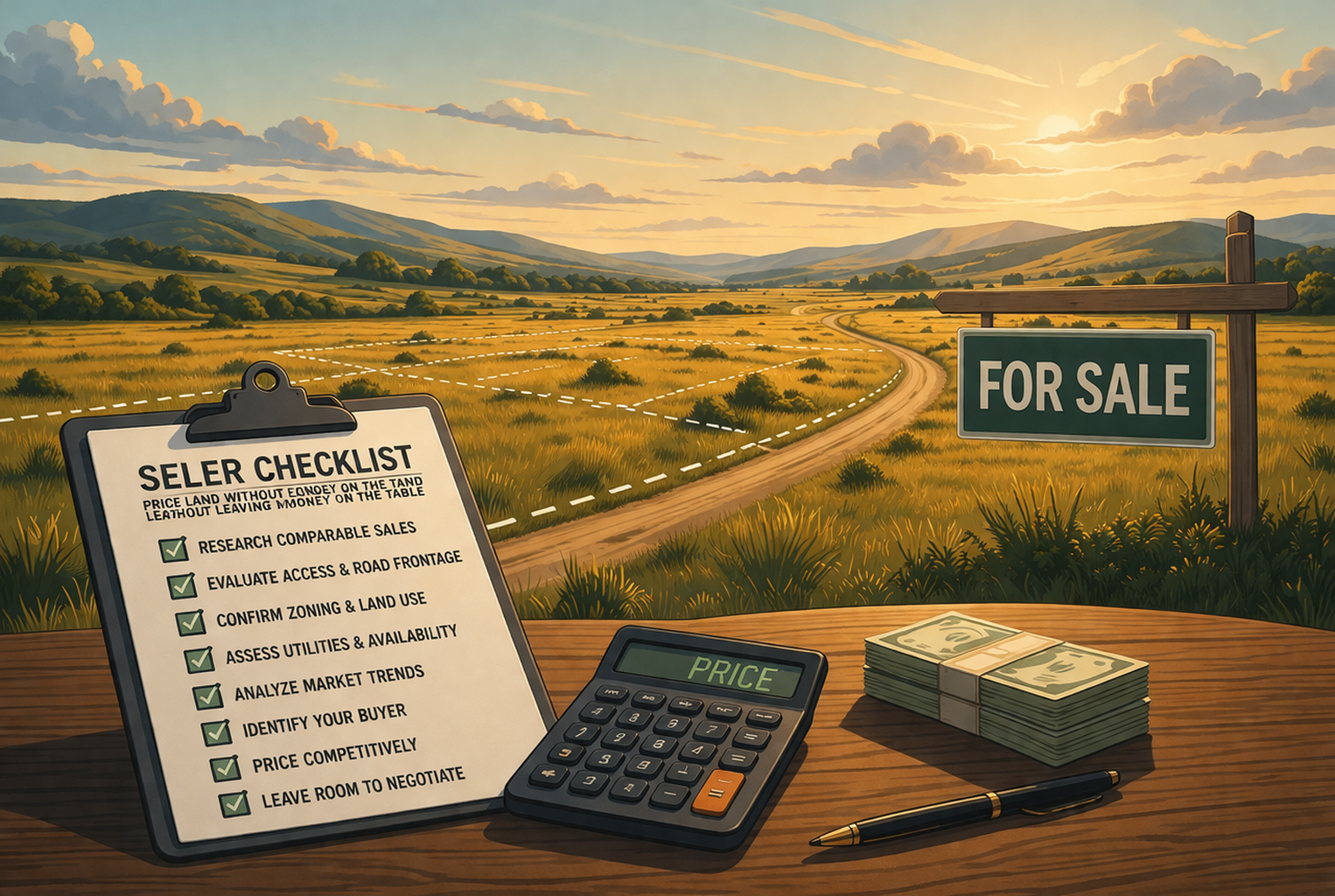
Pricing land correctly is one of the most overlooked—and most costly—mistakes sellers make. Unlike residential real estate, there are fewer comps, less transparency, and a wider range of variables that can dramatically affect value. Price too high and your property sits for months. Price too low and you leave thousands—sometimes tens of thousands—on the table.
The key is not guessing. It’s working through a structured checklist that removes emotion and replaces it with data-driven clarity.
Start With Comparable Sales (But Adjust Aggressively)
Land comps are not as straightforward as home sales. Two parcels that look similar on a map can vary drastically in value based on access, zoning, and utilities.
Focus on recent sales within the last 6–12 months, similar acreage within about twenty percent, the same zoning classification, and proximity within a few miles. Then adjust based on real differences. Better access increases value. Utilities increase value. Paved roads increase value. Irregular shape or slope decreases value.
Avoid copying list prices. Closed sales tell the truth.
Evaluate Access Like a Buyer Would
Access is one of the fastest ways buyers discount land, often heavily. Consider whether the property has paved access or only dirt, whether the road is maintained year-round, and whether access is legally recorded.
If access is unclear or inconvenient, buyers will discount the property. Pricing should reflect that reality upfront to avoid long listing times.
Confirm Buildability and Use Case
The most valuable land has a clear and immediate use. Determine whether a home can be built, whether minimum lot size requirements apply, and whether setbacks or restrictions limit usable space.
If your parcel has limited usability, it must be priced accordingly. Buyers do not pay premium pricing for uncertainty.
Factor in Utility Costs Even If Not Installed
Buyers mentally subtract future costs from your asking price. Consider the distance to the nearest power line, the cost to drill a well, and whether septic installation is feasible.
If utilities are not readily available, your price should reflect the total cost a buyer will incur to make the land usable.
Analyze Days on Market for Similar Listings
The market provides direct feedback. Look at how long similar properties are sitting, whether they have had price reductions, and whether listings have expired without selling.
If comparable properties are sitting for extended periods, the market is rejecting those price levels. Position your pricing within a competitive range to attract attention early.
Identify Your Buyer Type
Not all land buyers evaluate property the same way. You may be selling to a developer seeking margin, an end user planning to build, or a recreational buyer.
Each group values land differently. Pricing should align with the most likely buyer profile, not an idealized one.
Use Price Bands Instead of Exact Numbers
Pricing psychology matters. Instead of listing at a number like 102,500, consider positioning within a common search threshold such as 99,000 to capture more visibility.
This increases exposure and brings in more qualified buyers earlier.
Leave Room for Negotiation Without Creating Doubt
Buyers expect some negotiation, but only within a reasonable range. If the price is too high, you get no offers. If it is too low, you get immediate offers but risk underpricing.
The goal is to price slightly above your bottom line while staying grounded in comparable data. This creates healthy negotiation instead of silence.
Reassess Every Two to Three Weeks
Land markets move slower, but inactivity still signals a problem. Track views, inquiries, showing requests, and offer activity.
If there is no traction after a few weeks, the market is giving feedback. Adjust early rather than letting the listing become stale.
Final Takeaway
Pricing land correctly is not about optimism, it is about alignment with reality. Strong sellers approach pricing as a strategic process that combines comparable sales, property fundamentals, buyer psychology, and current market behavior. When done right, pricing becomes a competitive advantage that attracts serious buyers quickly, generates stronger offers, and reduces time on market. The goal is not just to sell, but to sell efficiently, confidently, and at a price that fully reflects the land’s true value.
1 comment